


Meridian Mappings: Symbolic Anatomy and Global Medicine
I was honored to sit down with Z’ev Rosenberg for a wide-ranging conversation on the nature of anatomy, tradition, culture and more.
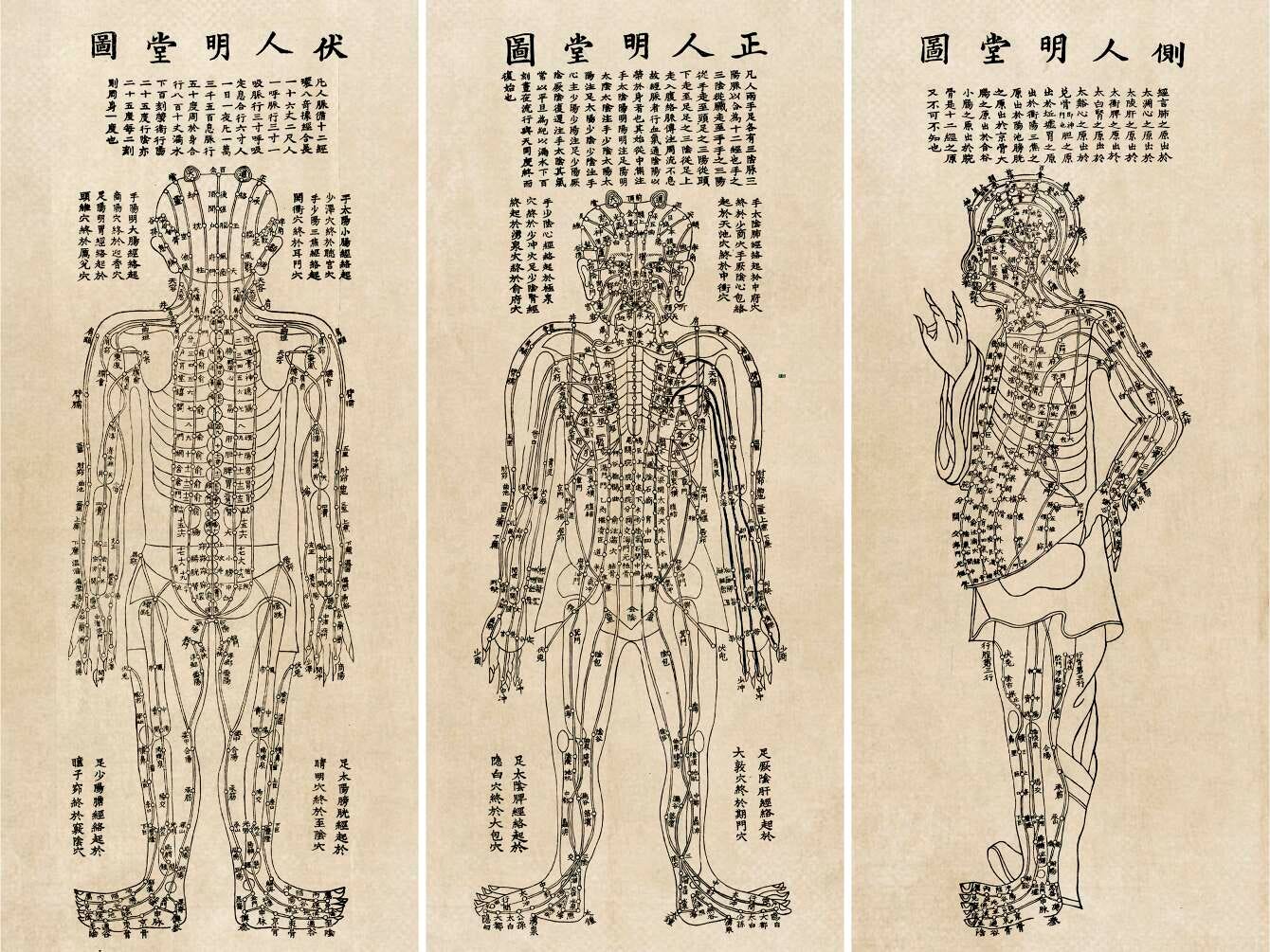
Our dialogue oscillates around Lan Li’s publication, Body Maps, an anthropological study of the “graphic genre” of meridian drawings in Chinese medical history. In the preface of the text, Li writes:
It was from the visually absolute inscription of a line and a dot that physiologists grew to question whether knowing where meridians lay defined what constituted them. Place somehow presumed essence. Meridian tu manifested the uneasy relationship between aesthetic practice and ontological judgment. Conflating what meridians were to where they appeared on paper gave anatomical images power. Reading meridian tu as body maps pinned meridians to a place on the page. It confused the sign with the signified. (Li, xiii).
Z’ev and I open the field by discussing this quotation. As we move through its meanings, we touch upon the symbolic and the empirical, medicine as a map of relatedness, the path of the scholar-physician, the ecological dimension of medical knowledge, and the evolution of medicine in a changing world.
In the afterglow of speaking with Z’ev, I found myself reflecting on the resonance of shared networks, classical thinking, and intergenerational dialogue. How we are still discoursing meridians, centuries after they were first written.
This conversation also follows my recent essay, Méridiens du Parlêtre, where I explored meridian lines as symbolic structures of the unconscious.
Chapter Annotations
00:00 – Meridians as Body Maps
Lan Li’s Body Maps, the problem of mapping meridians onto nerves, and how anatomical images confuse the sign and the signified.
07:30 – Symbolic Anatomy as Empirical
Symbolic structures as palpable and knowable; meridians as multi-dimensional structures; meridian drawings as structured like a rebus.
17:30 – Chinese, Tibetan, and Ayurvedic Anatomies
Comparing meridians with Indo-Tibetan nāḍīs and humors; why Tibetan medicine never developed a true meridian system; five-element paradigms; plural medical canons.
26:30 – Pulse, Metaphor, and the Scholar‑Physician
Pulse as “movement in the vessels”, natural imagery in the Mai Jing, and the distinction between technician and scholar‑physician.
36:00 – Chemicals, Ecology, and ‘Engineering’ Medicine
Chemical medicine, toxins, and the limits of the engineering model; quality of life, chronic disease, and the environment.
47:00 – Ethics, Home Clinics, and Medical Freedom
Working from home, patients as family, and the ethics of not subordinating a symbolic–ecological medicine to throughput and billing.
56:00 – Worsley, Five Elements, and Neoclassicism
Worsley tradition as syncretic and neoclassical; the Nanjing as a source-text of acupuncture; the discovery of style.
1:04:00 – Epidemics, Climatology, and Warm Diseases
Warm diseases, climate change in the classics; Tibetan medical views of epidemics as ecological violations; wu yun liu qi and host–guest qi in a disrupted world.
1:12:00 – Circadian Rhythms and Ministerial Fire
Circadian biology; nature as medicine; Li Shizhen on petroleum and fire; Z’ev’s upcoming book A Room Without Mirrors.
1:18:00 – Global Medicine and Medical Pluralism
Silk Road medicine; medicine as inherently global and plural.
1:23:00 – Closing Threads: Jing as Classic, Thread, and Meridian
Medicine as a way of life and what it means to weave a living fabric of medicine today.
About Z’ev Rosenberg
Z’ev Rosenberg, L.Ac., began his studies of Asian schools of medicine in the early 1970’s, with studies in macrobiotics, shiatsu, and theory of Chinese medicine.
He received a degree from the Santa Fe School of Natural Medicine in Western herbal medicine and body therapies in 1976, Kushi Institute (Boston, Massachusetts) in 1979 in macrobiotic counseling, Southwest Acupuncture College in 1983 in Acupuncture and Oriental Medicine, and Emperor’s College of Oriental Medicine in 1989. He worked as a macrobiotic counselor and shiatsu practitioner throughout the 1970’s, and has been in full-time practice in acupuncture and Chinese herbal medicine since 1983. At present, Z’ev maintains a private practice in herbal medicine and acupuncture/moxibustion with a specialty in chronic autoimmune disorders.
Z’ev terms what he practices as ‘full-strength Chinese medicine’, designed to manage and treat difficult conditions. He also directs the Alembic Institute, where he teaches advanced seminars in medical classics, pulse diagnosis, and treatment of autoimmune disorders.
Z’ev has written articles for several professional Chinese medical and macrobiotic journals, and is a consultant and product developer for Kan Herb Company in Santa Cruz, Ca. He continues to write articles for professional journals and has published several books:
Returning to the Source: Han Dynasty Medical Classics in Modern Clinical Practice
Ripples in the Flow: Reflections on Vessel Dynamics in the Nàn Jing
Humming with Elephants: A Translation and Discussion of the “Great Treatise on the Resonant Manifestations of Yīn and Yáng” with Sabine Wilms
References
Flaws, Bob. The Pulse Classic: A Translation of the Mai Jing by Wang Shu-he. Blue Poppy Press, 1997.
Gyatso, Janet. Being Human in a Buddhist World: An Intellectual History of Medicine in Early Modern Tibet. Columbia University Press, 2015.
Gyatso, Desi Sangyé. Mirror of Beryl: A Historical Introduction to Tibetan Medicine. Translated by Gavin Kilty. Wisdom Publications, 2010.
Li, Lan A. Body Maps: Improvising Meridians and Nerves in Global Chinese Medicine. John Hopkins University Press, 2025.
Manaka, Yoshio. Chasing the Dragon’s Tail. Paradigm Publishers, 1995.
Unschuld, Paul U. Nan Jing: The Classic of Difficult Issues. University of California Press, 2016.


