

A knot may have been tied for long, and yet it can be untied.
A closure may have lasted for long, and yet it can be opened.
If someone says an illness with a long duration cannot be removed, then that is simply an erroneous statement.
—Huang Di Nei Jing Ling Shu
Circulatory tree, arbor vitae of the cerebellum, lead tree or silver amalgam crystals precipitated into a tree that conducts lightning, is it your countenance that traces our destiny for us in the fire-scorched tortoiseshell, or your flash that brings forth from an infinite night that slow change in being in the En panta of language?
—Jacques Lacan, Écrits
Author’s Note
The body of this essay is comprised of five succinct parts:
I. The Warp and Weft of the Speaking Body
II. The Littoral Terrain
III. A Punctuation of Dreams
IV. The Body Without Organs
V. The Clinic of the Real
The style is condensed and aphoristic rather than expository and explanatory. After completing the text, I decided to add an overture to contextualize my theoretical moves in historical and conceptual terms.
My method is discursive and rhetorical—to write the shared discourse of acupuncture and psychoanalysis, and read their inscriptions to each other.
Some readers may prefer to dive headfirst into the body of the text only to return to the overture for afterthoughts; others may prefer a preface before entering the ambiance of the text.
This being said, I stake no claims. My only wager is a structure of inverted forms, suitable for efficacy.
Overture
Free Associations for a Floating World
From Meridian Therapy to Meridian Analysis
Historical Antecedents
Acupuncture and psychoanalysis are subjects rarely spoken in the same breath. Their histories are vastly different in scope and locus—but I hope to show that their similarity is not across a frontier but through a neighboring landscape. That is, acupuncture and psychoanalysis are distinct languages with common roots in unconscious scripts.
If acupuncture and psychoanalysis can be read as functional articulations of unconscious structures, then it is the consequence of a communicable discourse already embedded at the root. Does discourse have a rhizomatic structure? Are acupuncture and psychoanalysis lateral developments, with anterior methodologies and radial diagnoses? If we follow this line of inquiry, we will be led to a concordance, rather than a synthesis.
We see the first intimations of a convergence between acupuncture and psychoanalysis in the early-to-mid-twentieth century, when both fields were experiencing a renaissance along parallel lines. But these lines of development only met in anticipation of a nexus.
In the early-twentieth century, Japan was facing the influence of modernization in relation to traditional acupuncture—centuries of practice were being revised in the arbitrary image of the West, as Shudō Denmei recounts:
In 1918 the government commission on acupuncture education compiled the so-called ‘revised acupuncture points,’ which became the standard for licensure. The revised acupuncture points bore no resemblance to the traditional meridians and points, but were arbitrarily arranged according to a grid system superimposed over the surface of the body.1
In reaction to this Westernizing trend, a group of Japanese acupuncturists began to advocate for a return to the classical source-texts of acupuncture, where they could retrace the anatomy of their medicine. Following the efforts of Yanagiya Sorei, the neoclassical movement known as keiraku chiryō, or “meridian therapy” was born.
The meridian therapy movement not only returned to the classics of acupuncture but also to a classical period in the history of Japanese acupuncture.2 Yanagiya championed the “traditional approach to acupuncture and moxibustion” and “contended that the information in the classics was valuable but not infallible. He believed that all classical approaches had to be examined with a critical eye, put into practice, and discussed among practitioners before their worth could be determined”.3
By the 1930s, Yanagiya had founded a school dedicated to his motto, “Study the classics!”. Practitioners of meridian therapy took to the Classic of Difficulties as rigorously as Lacan took to The Interpretation of Dreams. And they each carefully deciphered and codified a system of practice “that had never before been so clearly defined”.4
Meridian therapy reached Europe in the mid-1950s, when Yanagiya traveled to France at the invitation of the French International Society of Acupuncture and Moxibustion. Yanagiya’s arrival follows a fertile landscape in French acupuncture and psychoanalysis: Soulié de Morant had published the first Western compendium on acupuncture, L’Acuponcture chinoise, and Lacan had formalized his return to Freud in the seminar.
Meridian therapy develops along a similar longitude as Lacanian psychoanalysis. The closest historical parallel between them is a loop of influence between France and China via Soulié de Morant, a French diplomat to China who not only spoke Chinese but also learned acupuncture from Chinese masters. As Eckman notes, “I think we can say that contemporary traditional acupuncture in the West, whatever that is, started with George Soulié de Morant in 1927 in France”.5 In this sense, the history of acupuncture in France has an earlier inception than Lacan’s psychoanalytic school. But by the 1960s, both movements were in full swing.
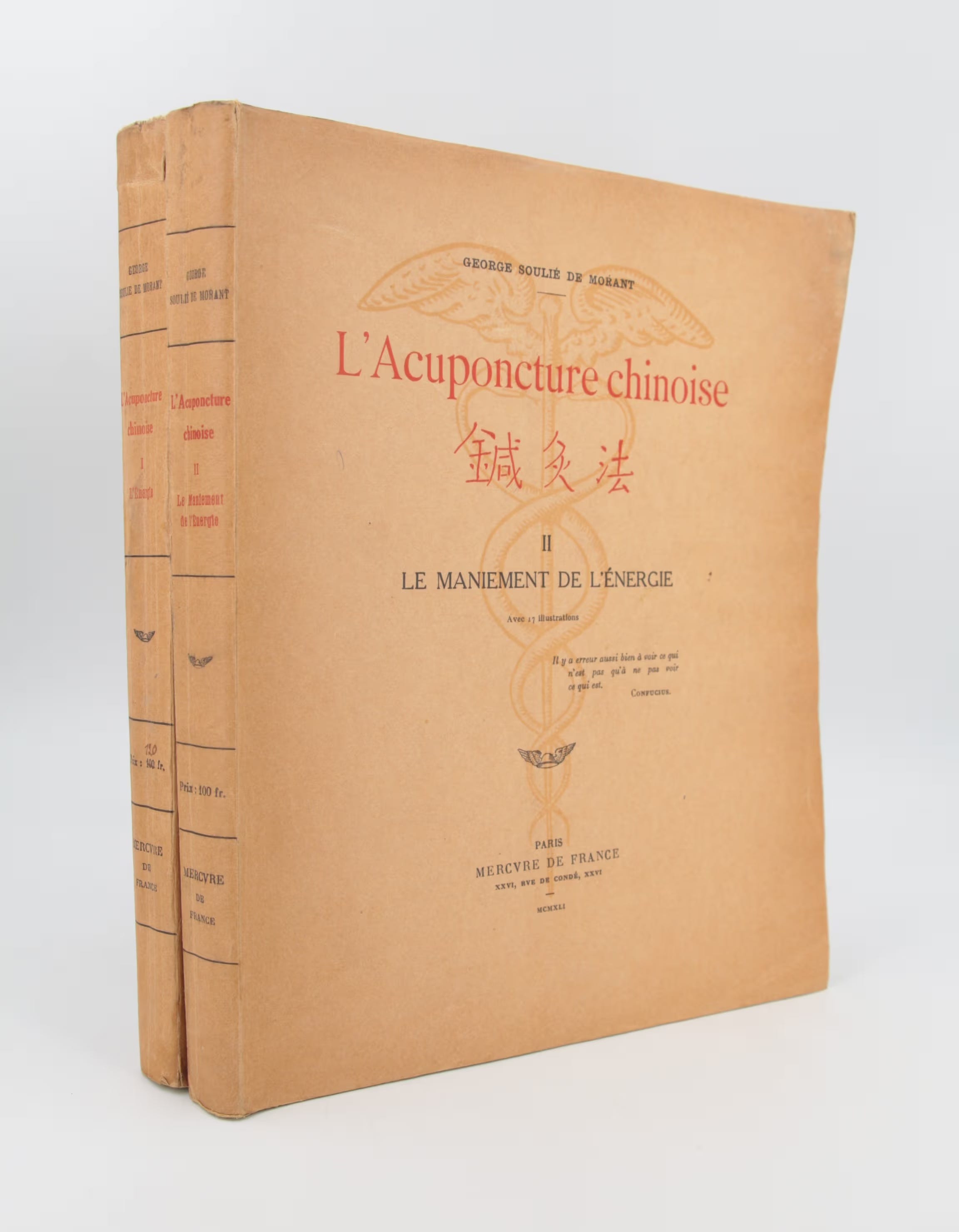
Soulié de Morant’s magnum opus, L’Acuponcture chinoise, was published from 1939 to 1941, but the complete text was published posthumously in 1957. L’Acuponcture chinoise is a remarkable text in the history of acupuncture. Soulié de Morant not only translates classical Chinese and Japanese texts, he collects a diversity of East Asian traditions—Chinese, Japanese, Vietnamese, and Korean—in a single place. His condensation of East Asian styles makes legible a pluralism intrinsic to the tradition of acupuncture, collating their ethic amidst a new cultural intersection.
Soulié de Morant treated prominent Parisian artists and intellectuals, including Maurice Ravel, Atonin Artaud, Jean Cocteau, Wassily Kandinsky, and Marie Bonaparte.6 Soulié de Morant’s collaborative relationship with Bonaparte is especially notable, since it marks what may be the sole historical convergence between acupuncture and psychoanalysis. Marie Bonaparte was not only the grandniece of Napoleon, she was an ardent follower of Freud, and helped establish Freudian psychoanalysis in France.
Bonaparte asked Soulié de Morant to translate the Yùxiájì (Memories of the Jade Box), a classical Chinese book on dream omens and their interpretations (ca. 239 BCE). In 1927, Soulié de Morant published his translation of the text alongside Bonaparte’s annotations as Les rêves étudiés par les Chinois in Revue française de psychanalyse—the same year that Freud published The Future of an Illusion and the English edition of The Question of Lay Analysis, and Lacan began his clinical psychiatry training at Sainte-Anne hospital.
Soulié de Morant belongs to a tradition of lay practice that Freud advocated for, a mode of work that moves from the institutional to the avant-garde and from academic discourse to analytic discourse. The question of lay practice that faces psychoanalysis also confronts acupuncture, even while the latter has secured both theoretical standardization and regulatory verification to ensure the limits of its “licensure”.7
Synthetic Precedents
Compared to acupuncture, psychoanalysis appears to be a new discipline, founded on Freud’s articulation of the unconscious. But this does not leave psychoanalysis without its antecedents in antiquity. Yanagiya’s “return to the classics” and Lacan’s “return to Freud” are Renaissance movements that revolutionized their respective fields through a retrograde motion. They each find new beginnings for their field at a point of origin, and thus precipitate a future direction. Lacan not only traces psychoanalysis to its founding moment in Freud but to the liberal arts of the Middle Ages—“the series going from astronomy to dialectic by way of arithmetic, geometry, music, and grammar”—that “foreground what might be called a fundamental relation to human proportion”.8
Human proportion is a constitutional ratio and a spatiotemporal complex. By citing the liberal arts, Lacan is suggesting that psychoanalysis concerns itself with constitutional structures. He elaborates:
At the present time, psychoanalysis is perhaps the only discipline comparable to those liberal arts, inasmuch as it preserves something of this proportional relation of man to himself—an internal relation, closed on itself, inexhaustible, cyclical, and implied pre-eminently in the use of speech.
It is in this respect that analytic experience is not definitively objectifiable. It always implies within itself the emergence of a truth that cannot be said, since what constitutes truth is speech, and then you would have in some way to say speech itself which is exactly what cannot be said in its function as speech.9
If the unconscious is a structure that is structured like a language, then it is constituted in proportions unique to the speaking body. As Lacan says, “Language is what constitutes xing, nature”.10 In the context of Chinese medicine, xinghas the connotation of “constitutional nature”. Lacan makes the link between language and constitution clear when he analyzes the Chinese character yan, which “means nothing other than language, but like all terms in Chinese, it can also be employed as a verb. Thus, it can mean both ‘speech’, and ‘what speaks.’ What does it speak? That would, in this case, be what follows—namely, xing, nature . . .”.11
The Freudian map of the unconscious is a topography of the psyche as a structure of signifying associations. The meridian anatomy of the Chinese is a topography of the psyche, written across the signifying terrain of the body. What happens to medicine and psychoanalysis when we take the unconscious as a psychosomatic constitution? If we cannot objectify the proportions of the psyche and soma, then what remains is a ratio of articulation, measured for the moment of its puncture. Thus, acupuncture apportions the body as a field of language through which speech functions.
By the 1960s, European practitioners had begun to absorb acupuncture into the milieu of psychosomatic approaches, in a field inaugurated by Georg Groddeck, a German physician and psychoanalyst who influenced Freud’s concept of the id (das Es).12 In 1965, Denis and Joyce Lawson-Wood published Five Elements of Acupuncture and Chinese Massage,13 an early and influential English-language book introducing acupuncture. In a chapter titled “Psychological Considerations”, they raise the question of synthesizing acupuncture with psychoanalysis.
They open their argument by referencing the work of French physician, Roger de la Fuÿe (a student of Soulié de Morant who promoted a synthesis between acupuncture and homeopathy in his treatise, Traité de’acupuncture). De la Fuÿe referred to his approach as “homeosiniatry”, basing it on a combined repertory of acupuncture points and homeopathic remedies.14 Highlighting de la Fuÿe’s approach to clinical synthesis, the authors write:
Doctor de la Fuÿe emphasizes, and we re-iterate and emphasize this also, that a practitioner must be supple in his outlook and not seek at all costs to make any one method triumph over all others. Above everything else the practitioner must have the desire to heal the patient: and, he says, it would be evidence of narrow-mindedness to reject a priori a synthesis of acupuncture and other methods on the grounds that such a synthesis of methods is not in strict accord with the ancient tradition of ‘pure’ acupuncture.15
This admonition applies equally to psychoanalysts: we must not seek the exclusive triumph of the psychoanalytic method for the sake of a “pure” ideal. The only purity of psychoanalysis is the presence of the speaking subject. Any other erection of purity leaves psychoanalysis impotent in the words of its own sanctimony. For Lawson-Wood, the question of modality is secondary to the primacy of the healing act: “The ideal therapist is one whose spirit is pliable enough, and whose knowledge is broad enough for him to use at one and the same time the quintessence of all known reputable methods”.16
From here, the authors mention Groddeck before formulating a link between acupuncture and psychoanalysis in “the treatment of the psyche”: “When we talk about treatment of the psyche we are not thinking in terms of modern Western psychiatry, with use of shock and drugs, but rather in terms of psycho-analysis and systems derived therefrom”.17 This leads them to pose two issues they associate with psychoanalytic treatment:
(a) Psycho-analysis, from the patient’s point of view, can be an expensive way of having the psyche treated; especially as a beneficial outcome is by no means certain.
(b) Whether it is in the end successful or not, psycho-analysis seems inevitably to be accompanied by a great deal of emotional torment and distress.18
It is difficult to know which methods of psychoanalytic practice or thought were familiar to the authors in formulating this critique.19 Regarding expense, the cost of treatment is typically seen in proportion to the frequency of treatment—and, in this realm, psychoanalysis has privileged an intensive format. Freud typically saw patients for analysis six days a week. Today, it is more common for psychoanalysts to see patients on a weekly basis—the same frequency with which patients also see their acupuncturist.
Who is to say which method is a greater source of distress—the scansion of the subject’s speech or the physical puncture of their skin? It is erroneous to locate these subjective experiences in an objective method of treatment. Patients may engage in analytic work for years, but they may also see their acupuncturist for decades. The duration of healing work is less questionable when we re-locate their effect in the logical time of a preventative praxis. But the question remains: how do we arrive at the “success” of any given treatment, regardless of cost and duration?
The authors continue to suggest that acupuncture may provide a more efficient pathway to the treatment of the psyche than psychoanalysis:
It is desirable, therefore, that there should be some alternative and far speedier method of resolving analytical problems. But this does not mean to say that we regard Chinese acupuncture by itself as an alternative to psycho-analysis in all cases; but rather do we intend to convey a judicious use of Chinese acupuncture points can serve as an extremely useful technique for bringing about more rapid results, without torment, and with greater predictability.20
This critique hinges upon a proper understanding of so-called “analytical problems”, or more accurately, symptoms of the unconscious. If we appreciate that such symptoms are necessarily psychic and somatic, then the question of method becomes the substance of a ritual.
In my clinical work, I have observed an equivalent efficiency between psychoanalysis and acupuncture, as well as the inverse. This is to say that the questions of efficiency and “resolution” are irreducible to method, but are rather a question of discernment on the part of the practitioner. It is perhaps less a question of “which” but of “who” and “when” and “what for”. At a specific point in the analytic process, the frame itself functions beyond the question of intervention and within the locus of transference. It is thus within the palpatory grasp of the practitioner’s hand to determine the precise dialectic of their clinic.
Despite their criticism, the authors conclude their thoughts by positing a classical link between acupuncture and psychoanalysis:
If anyone wants classical justification for linking psycho-analysis with acupuncture, we draw attention to the passages in the NEI CHING dealing with interpretation of dreams. Several thousand years before Freud the Chinese recognized that dreams represent a mechanism for symbolic wish-fulfillment.21
The authors are referring to the classical source-text of Chinese medicine, the Huangdi Neijing (Yellow Emperor’s Inner Classic). In chapter seventeen, “Discourse of Vessels and the Subtleties of the Essence”, the text discusses the affective dimension of dreams and correlates them with organs and elements.22 It is true that the topic of dream interpretation precedes Freud by millennia, as the therapeutic significance of dreams has been recognized for thousands of years in Ayurvedic, Tibetan, and Chinese medical texts.
Freud’s contribution is to chart the phenomenon of dreams within the associative network of the patient’s speech. As Lacan points out, “For a dream is not the unconscious but, as Freud tells us, the royal road to it. This confirms that the unconscious proceeds on the basis of metaphorical effects”.23 Lacan proceeds to situate the unconscious as a signifying structure:
Here, however, the path was not simply traced out for us by Freud: he paved the whole road for us with the most sweeping, unvarying, and unmistakable assertions. Read his work, open his texts to any page, and you will rediscover the foundational stonework of this royal road.
If the unconscious can be the object of a kind of reading that has shed light on so many mythical, poetic, religious, and ideological themes, it is not because it provides their genesis with the intermediary link of a sort of “significantness” of nature in man, or even of a more universal signatura rerum that would be at the core of their possible resurgence in each individual. Psychoanalyzable symptoms, whether normal or pathological, can be distinguished not only from diagnostic indices but from all graspable forms of pure expressiveness insofar as they are sustained by a structure that is identical to the structure of language. By this I do not mean a structure that can be situated in some sort of supposedly generalized semiology which can be drawn from its limbo regions, but rather the structure of language as it manifests itself in what I will call “natural languages,” those that are effectively spoken by human groups.24
Psychoanalysis teaches us that the locus of symptoms—whether psychic or somatic—is in the unconscious, and that a “symptom is language from which speech must be delivered”.25 The symptoms of meridian imbalance are thus analyzable symptoms, treatable through a tonification or scansion of signifiers. “It is via speech, of course, that a pathway toward writing is paved”.26 And this is where Lacan locates the double-transcription of xing and ming, what is inscribed by nature and what is what is written—“The shift occurs between xing, nature—such as it is, owing to the effect of language, inscribed in the disjunction between man and woman—and ming, heaven’s decree, this other character . . . meaning “it is written,” the character freedom shrinks from”.27 Xing and ming is the double transcription that codes the fate and ciphers the destiny of the speaking body.
The analysis of a symptom is the punctuating of a text, written across a signifying body. To puncture and to punctuate is to “point out”, to show the punctum that is the navel of the line. Soulié de Morant says, “It would seem that the action of puncturing is very simple and can only be accomplished in one way. However, the word ‘puncture’ has three meanings: the action of puncturing, the excitation produced by the puncture, and the trace produced”.28
These three meanings can be placed into the three registers of the unconscious: the action of puncturing is imaginary; the excitation produced by the puncture is a symbolic effect; and the trace that remains is the letter in the real.
Here, we approach the body ecologic at its littoral zone. As Lacan says, “What constitutes the ground of the littoral is the crossing out of any trace that may been there before”.29 Whether the punctuation of an associative discourse or the puncture of an associative meridian, it is we who must see the “imperceptible trace of . . . the gazelle’s footprint on the rock”.30 We must “listen for what lies beyond discourse” by taking “the path of hearing, not that of auscultating”.31 A riverbed where currents of discourse once ran, now only the inscriptions of a leitmotif left to read in the lituraterre of the speaking body.
Après-Coup: Sinography as Semanteme
In the language of Asian medicine, we also find signifiers for unconscious structures and processes, for drives and their vicissitudes, for somatic symptoms and their psychic origins. Acupuncture is founded on a symbolic language that describes the functional apparatus as a psychosomatic structure. The symbolic order is a circulation of signifiers that move in a möbius channel of signification. The body does not keep a score but a name of functions that invoke a symbolic law.
Soulié de Morant’s translation of jīng as “meridian” is now in vogue to detest. Some accuse Soulié de Morant of inventingan imaginary meridian paradigm that is alien to the “scientific” basis of Chinese medicine. These claims privilege a scientific materialist reading of acupuncture that aims at its legitimization in the defiles of colonialist medicine. The new trauma is inflicted from within its co-optation. The trouble is an age-old confusion between the imaginary and the symbolic amidst a naïve realism.
Instead of “meridian”, the term “channel” is advocated as standard nomenclature. Instead of a geography of the body, they prefer the imperialism of chemical signals and vascular pathways, an altogether dissected vessel emptied of symbolic notions for the sake of imaginary captures by false prophets of reality. But to read coffee grounds is not to read hieroglyphics. Acupuncture is not a figment of imagination, projected onto a body double—it is a signifying system, as legible as a written language, whose rosetta stone it is our task to palpate and punctuate.
This becomes clear when we give Soulié de Morant’s translation the instance of another glance. He was not only a French diplomat to China but a polymath who learned the Chinese language from the age of eight and studied acupuncture in China during the cholera epidemic. Soulié de Morant was not only versed in acupuncture and linguistics but also in art, literature, music, theater, and history. Why did he choose the term méridien as a translation of jīng?
In the second chapter of L’Acuponcture chinoise, “The Twelve Meridians”, Soulié de Morant defines “meridian” and justifies his translation:
Knowledge of the meridians (jing), or lines of points, is an essential foundation for true acupuncture . . . The meridians give us an understanding of the relationships among the organs and help us to classify and analyze the effects of a point.
. . . The Yi Xue Ru Men explains (I, 1r): “The meridians (jing) are the longitudinal paths.” The ideogram used to describe these lines of points is formed by the elements “string-line-right-winding-work,” the idea being a string connecting a winding alley into a path. From the most ancient times, the term “jing” was used in astronomy for the lines of north-south longitude. It is still used in the countryside for the north-south paths of a field.
The pronunciation jīng has not changed since antiquity. The British transliteration is “ching” while the old French transliteration is “king.” Sometimes the name “jīngluo,” pronounced “keiraku” in Japanese, is used.3233
Chinese is a tonal language and, as such, words convey distinct meanings depending on their intonation. The term jīng, as in jīngluo (“meridian network”), is pronounced in the first tone. At the level of audition, it is thus indistinguishable from the jīng which means “essence”. Although the jīng of meridian and the jīng of essence are pronounced identically, they are written differently. English transliteration misleads us into the illusion of an identical text, since jīng is transliterated the same in both cases. But when we look at the ideographic script of Chinese writing, we see the distinction in plain sight:
經 jīng/meridian
精 jīng/essence
Let us look closely at the meaning of jīng (meridian). Jīng means “warp”, “longitudinal lines of the Earth”, “pathways of the sun, moon, and stars”, “channel”, “road, footpath”, “principle, law”, and “classical texts”. This polyvalence of meaning makes obvious the signifying nature of the word jīng. In other words, there is no translation that duplicates the meaning of jīng in a one-to-one correspondence; there are only chosen moments in the movement of its signifying chain.
Consider the definitions themselves:
As warp, jīng signifies the threads of a loom, a weave or mosaic, a quilted tapestry.
As longitudinal lines, jīng signifies a spatial plane of coordinates, angular distance and span, and an invisible (but locatable) topography.
As pathways of the sun, moon, and stars, jīng signifies an orbital plane, a celestial ecliptic, and an evanescent appearance.
As channel, jīng signifies a hydrological current, a pathway of irrigation, a furrow which conducts a symbolic passage, a groove which traces the sounds of time.
As road or footpath, jīng signifies transportation, traversal, and the vector of desire.
As principle or law, jīng signifies a symbolic order, a signifying chain, a structure of articulation.
As classical text, jīng signifies a timeless treasure, an enduring word, and a written pedagogy.
Soulié de Morant’s use of “méridien” is now evidently logical. The French meridien comes from the Latin meridianum, meaning “noon”, from medius, meaning “midday”. In astronomy, the term “meridian” describes the phenomenon of solar noon—when the Sun is directly overhead, it crosses a longitudinal meridian at its zenith. Is this not the “law of midday-midnight”34 that governs the logical time of meridian flows? The notion of meridian simultaneously signifies a longitudinal line and a point of intersection—a meridian is precisely the crossing-point of space and time.
This brings us to the Japanese translation, keiraku. Kei means “passing through” or “threading”, raku means “connecting” or “net”. The meaning of “passing through” resonates with the notion of “longitude” and “threading” resonates with “warp”. On a secondary level, keiraku means “thread of connection” or “chain of reasoning”. This meaning set brings us closer to the notion of a signifying chain that is both logical and related to itself, or analyzable.
Meridian Analysis
Does this not take us to the zenith where psychoanalysis articulates its field and function? “Analysis” comes from the Greek analuein, meaning “loosen”. What is loosened in analysis if not the very threads that course a signifying chain? The discourse of the body is already written upon its surface in threads of connection that await communication.
Chiryō means “treatment”, “cure”, “therapy”. Taken together, the phrase keiraku chiryō was consistently referred to in English as “meridian therapy” by the Japanese masters who founded this movement. With the phrase, “meridian therapy”, I felt the masters were not only placing themselves within an historical current at the precipice of a century, but in a momentary suspension in which the instant of their glance was set upon antecedents across milled annals of comprehending.
We cannot conclude an anxiety of influence that holds us still in a moment of temporal tension, suspended between classical threads of thought evolved through thousands of times. The future of medicine is neither a syncretic nor integrative but entirely radical. A return to roots still growing in microbiomes.
If what is classical is merely in step with the past, then how are we to ascertain the lagging moment that drags our feet behind the beat? The classification of classical is an assertive logic that attempts substantiation through historical associations in thought but not necessarily through word and deed. The verification of oral transmissions is a false deduction in the locus of its locution. The anxiety of influence is an existential angoisse, caught between the sense of what was and the discordance of where one is. Lineage becomes the spatial lure of associative lore rather than a treasure trove of scriptural transmission.
A claim is no more than an anticipated certainty, made with hesitant hands that needle synthetic threads. The truth is a dialectic across antiquity and culture, where medicine arose as a collective logic. But this collective is nothing but the subject of the individual.
The truth that depends on the rigor of each is a subjective assertion that will stand the tests of time by anticipating its own return. In returning to the classics, medicine receives its own message in an inverted form. The subject who practices is neither technician nor artist but a clinician of transference, where what is exchanged is not reciprocal but transmissible.
We seek not the duplication of the past in acts that bring us closer to nothing more than our own double, who is neither extant nor invisible but always looking back. The glance we catch is exactly our own, even when we hear it in oracular echoes.
What is divined has been heard before, what is seen has seen us first, and what is foretold has thrust itself upon us. What we listen for to hear a diagnosis and see a prognosis is neither a reflection nor a speculation but the anticipated certainty of an outcome. The intervention of medicine is ever in the company of the three times, where an omnidirection of its text is reciting truths still grasping another time.
This leads us to the revolutionary conclusion that what is classical is original, not a grade but an avant-garde. The experimental form of an intervention leaves half-spun threads open for another hand to loom. My response a century later is to move keiraku chiryō toward keiraku bunseki—from meridian therapy to meridian analysis—an intervention at the midpoint where the psyche meets the soma of a speaking being.
By emphasizing meridian therapy, the Japanese masters were resuscitating the classical locus of acupuncture intervention as meridian-based in distinction to the organ-based locus of herbal medicine. The meridian network is the symbolic layer of the body, a cartography not reducible to organic anatomy and physiology.
Psychoanalysis and acupuncture are symbolic interventions at the level of a linguistic field that is constituted as a chain of signification—a legible and palpable discourse. Psychoanalysis and acupuncture are differentiated by the implements of their intervention, but the essence of their logic is similar: listening to diagnose, hearing to punctuate, and seeing to anticipate.
As we move from therapy to analysis in all our interventions, we move through the registers of our respective fields and approach a clinic of the real. The movement of analytic acupuncture is framed at the intersection of two modalities, but the nature of their intersection is a broad spectrum truth that lives freely in every associative anecdote.
Rather than the administration of a therapeutic cure, meridian analysis attends to the discourse of the patient as a free-associative text, where punctuation is placed with acumen, an audible rendering of an unheard oracle. A physical needle puncturing a symbolic structure is an analytic act that takes the unconscious as the logic of its certainty. And there is an arrival of qi, likened to the feeling of a fish taking the bait, a sinking into subcutaneous signifiers at the tip of the signified, a current of junctures that irrigates the ebbs of speech.
Psychoanalysis and acupuncture are not parallel fields, but semblables likened across a discursive structure. Psyche and soma are the fields where the function of acupuncture and psychoanalysis intersect. The nucleus of their circumlocution is the chiastic composition of the unconscious. When we take acupuncture at the letter of its word, we will practice l’acupuncture parlétre—a method for the madness of the speaking subject.
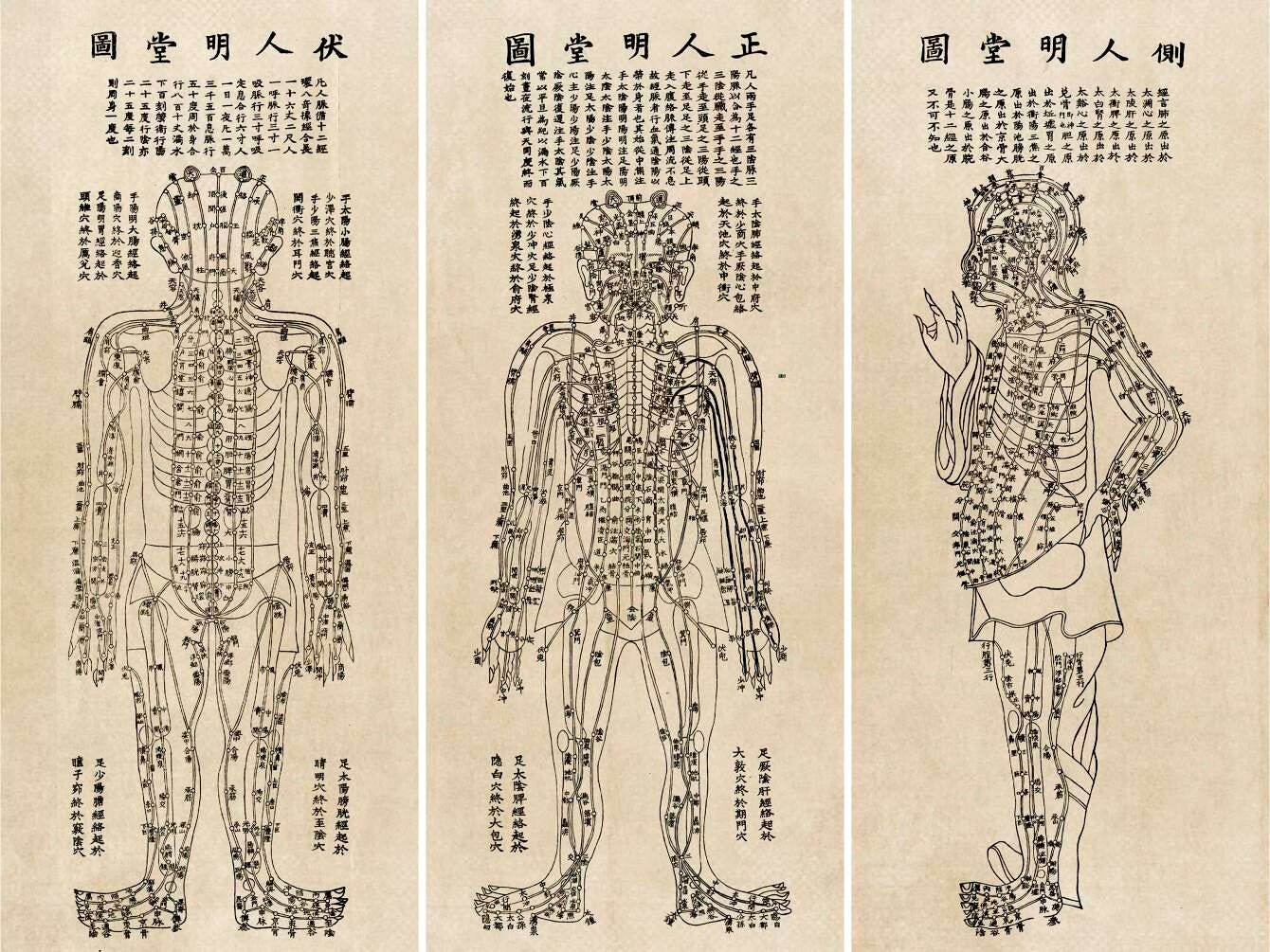
I. The Warp and Weft of the Speaking Body
The Body is Structured Like a Language
The meridians of the body are quilting points in a current of discourse, the nodal points where verbal forms intersect,35 where the signifier and the signified weave a symbolic order of language. The meridians are structured like a language, signified as they are by ideographic names that picture a law and order.
The name of the point is the holy spirit of the signifier; its character is a sinographic dream. The names-of-the-points are the names-of-the-father that encode the physiology with its heavenly qi.
Qi is the mechanism of the transference that powers communication and relatedness, or the very function of discourse as a social link. Qi is the transferential locus of the relatedness between the Umwelt and the Innenwelt, a likeness that yet yields a difference rather than a reciprocity. The meridians thus describe and inscribe the very meaning of our relatedness as a signifying chain of associations.
How is it that the Chinese drew a topography of twelve meridians that mirror a likeness to the twelve rivers of China? Is not language equally a dialectical phenomenon? The body is structured like a gaze, itself a body politic that is its own double. Thus, the body is structured like a landscape.
It is not that the body is natural or unnatural—it is the individual who inhabits it that is imaginary. The body is not merely biological but a bios of logia—an incarnation of words.
The body itself is an environs of existence, a terrain of signifiers sliding across slippery spheres. The body is in a chain of dependent origination that is discursive in nature. The body is a canvas of tattoos, a carving of diacritical marks in symbolic cuts, etchings of permanence on a mortal frame.
Méridien is the synchrony of noon in a diachrony of day. A spatiotemporal complex standing on a mirrored stage. A mediating structure between the imaginary and the real. A tapestry of language woven in a logic of time and a ratio of space.
The meridian has a pulsion that moves in elemental rhythms and elliptical cycles. The message of the meridian is heard in palpable sounds of diagnosis, where the current of discourse beats in meters and ellipses, scansions and excesses, where speaking stagnates in temporal dialectics and spatial lures skip in arrhythmia.
In neurosis, there is a repression of desire, either in obsessional deficiencies or hysterical excesses. The method is to tonify the meridian at the level of desire. The technique is gentle—moxibustion followed by subcutaneous needling. For the neurotic requires a return of the repressed in a symbolic form.
In psychosis, what is foreclosed reappears. The method is to balance the meridian at the surface of its boundary. The technique is non-invasive—moxibustion followed by non-insertive needling. For the psychotic already fears the penetration by structures they foreclosed, long before they could be erected for real.
In perversion, there is a disavowal of desire. The method is to sedate the meridian in the direction of its counterflow. The technique is invasive—cauterization followed by deep needling. For the pervert disavows what is lacking in a reversal of flows.
The presence of the needle initiates an echo in its absence through a symbolic alternation, where the subject hears the tonification of their own message, returned without a sender.
Acupuncture is thus a discursive intervention in the subject, an invocation that punctuates the symptom in a smoke of signifiers, drifting in divergence from a single space.
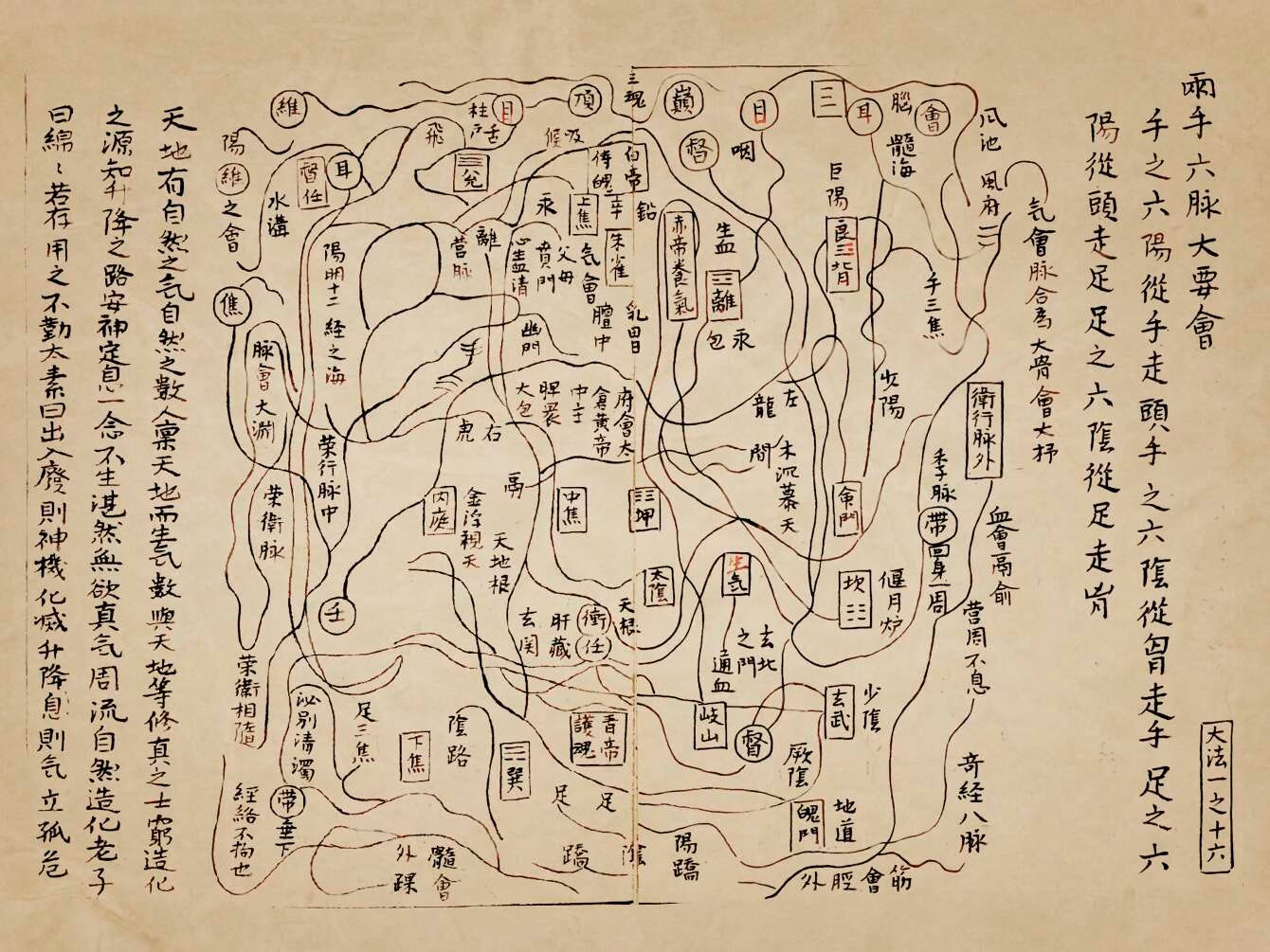
II. The Littoral Terrain
The Discourse of the Body Might Not Be a Semblance
The littoral is a literal terrain, a continental divide that constitutes the body ecologic. In Chinese medical anatomy, the natural terrain is mapped onto the human body.
The body is not only a living system but a terrain, a topographical locus with valleys and streams, rivers and seas, mounds and mountains. The body is not a system of correspondences but a juncture of semblances.
The human body derives a natural language without being reciprocal. Semblance is a littoral edge, not a reciprocal relation. There, where the meridian bends in the curve of the body is a geōgraphia—a writing of the earth.
Therefore, the terroir of the body is structured like a language—its breath an inspired writing, its blood an inked inscription. From where do we inhale the calligraphic ink and brush of anatomical character?
We palpate the meridians by hand, sliding across a gap of connective tissues, between the littoral and the literal. The points we palpate are skin-deep depressions made in singular strokes, traces of letters in the parting of clouds. There is no belly in the muscle, only a gully in the real.
To needle is to invoke and evoke a punctual dance of rain, an arrival of jouissance. “What is evoked of jouissance on the breaking of a semblant, this is what presents itself in the real as a gullying”.
The needle is a signifier that ensnares the letter in the net of semblance,[1] a lure of jouissance waiting to be caught. Where jouissance stagnates, the letter has no agency. To puncture is to reinvigorate an imaginary divide, to liberate a signifier in the symbolic order, to penetrate a hole in the real.
A puncture is a form of punctuating, a periodic break in a sentence that structures a communication. Therefore, the act of puncturing constitutes a discourse. For it is the body that speaks, and one only derives jouissance from it when the word of interpretation rains upon it. In the Ling Shu, it is said:
The essence of acupuncture is that the effect comes with the arrival of Qi. The sign of this is like the wind blowing the clouds away. It becomes clear and bright as if looking into the blue sky. This means the purpose of acupuncture has been fulfilled.36
There is no obtaining of jouissance because there is no relation in which or from which it could be obtained. There is only an invocation between Heaven and Earth, a gully where jouissance arrives like a tidal wave, to part the clouds on the shore of the real.
Acupuncture is a discourse of the body, where the needle initiates a littoral link in a brush with jouissance. Therefore, Sugiyama says, “When there is sinking, heaviness, dullness, tightness, and fullness after the needle is inserted, and it feels as if a fish has swallowed the hook, and there is movement which seems sinking at one moment and floating at another, it means the Qi has come.37
Qi arrives in the form of a discourse in the sound of a social link. What then is the discourse of the acupuncturist? And does it resemble the discourse of the analyst?
The acupuncturist diagnoses the meridian in need of puncture by listening to the twelve pulses. Are these pulses not pulsions—radial urgencies, speaking to the ear?
The acupuncturist thus diagnoses by sound, where what is heard is an invocatory pulsion, in the voice of desire. The acupuncturist diagnoses by sight, where a scopic pulsion meets the gaze of the eyes in the chromatic of desire. The acupuncturist diagnoses by smell, where an olfactory bulb is the pulsion of an orifice, an aromatic of demand. The acupuncturist diagnoses by emotion, where the affect of transference is a pulsion of projection devoid of interpretation, mouthed as an edible demand.
An acupuncturist thus listens to hear and see the causative shape of the subject’s demand and desire, to locate an elemental pulsion in a course where clouds of jouissance gather to precipitate an impulse in the circuit of the real.
Acupuncture treatment is nothing more than the arrival of punctuation in the discourse of the speaking body. A talking cure is not necessarily a spoken cure, but it is a cure whose evidence is found in speech.
Therefore, the biggest mistake we can make as acupuncturists is to forgo the speech of our subjects by presuming an epistemological superiority via subtleties, when it is the speaking body of the subject that provides the articulation we wish to punctuate.
Acupuncture is an interlocution, an orthographic incision between language and speech, where every thread rests on the skin of the real. We will know if our treatment has been effective not by what we feel and see, but by what the subject says. Therefore, the acupuncturist and analyst are both punctuators of a discourse that may not be a semblance.
The role of the acupuncturist and analyst is to help the subject meet the mark, wherever their transcription is presently amiss. In doing so, the subject’s symptom is translated to a sinthome, where the knots and weaves of meridians and points become the warp and weft of aesthetic ecstasy.
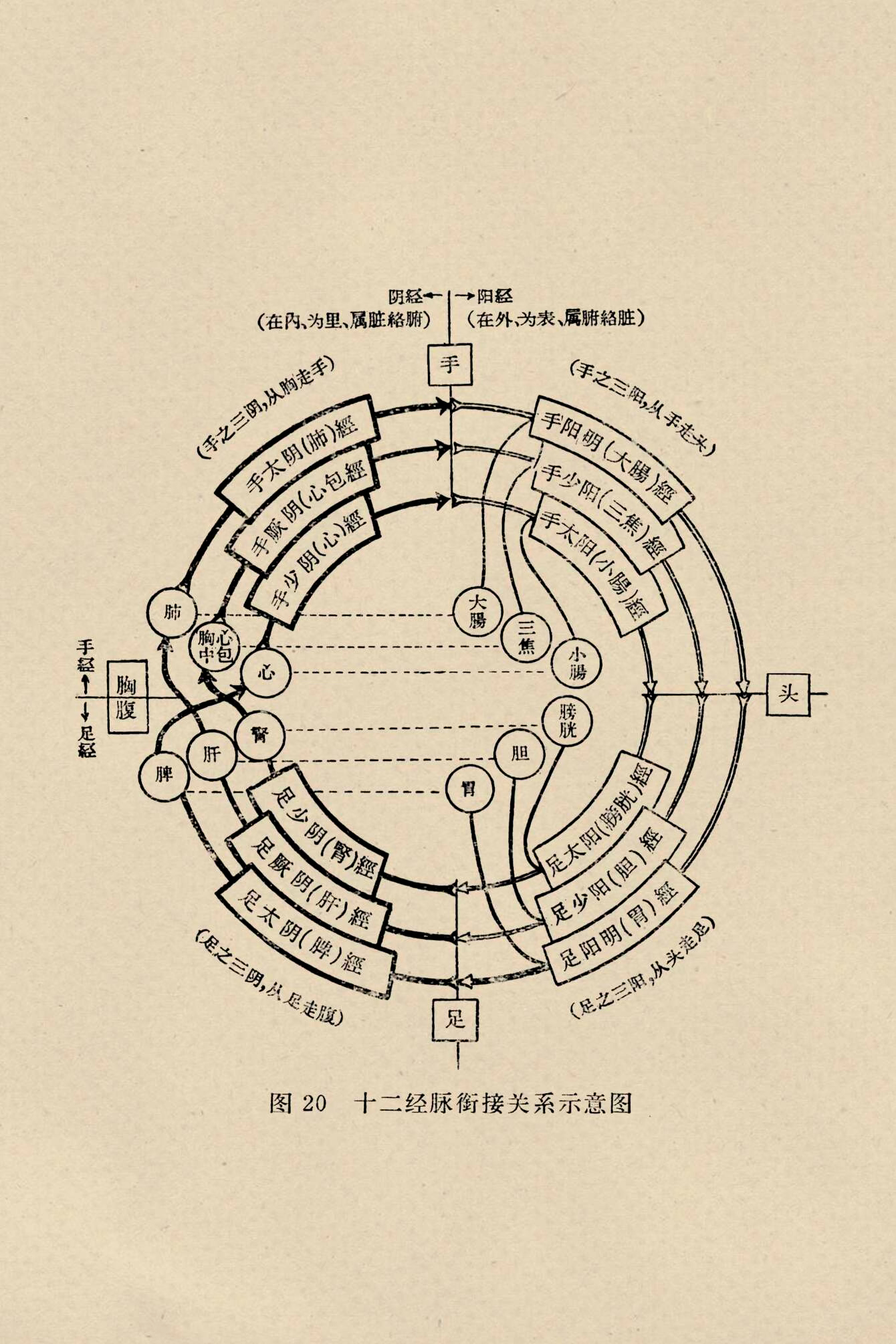
III. A Punctuation of Dreams
A Physiology of Interpretation is an Anatomy of Destiny
The meridian network is a physiology of dreams, ciphered in anatomical lines of destiny.
The intersection of function and form is legible as nodal points in a signifying chain, a meshwork where desire grows up its fruiting body in myofascial forms of communication.
The navel of the dream is the abdomen of the body, where the tangle of dream-thoughts reaches unknown depths, unfurling uncharted territory in a remembered course of desire.
Diagnosis is an analysis of the surface, a palpation of the body at the radius of its pulsion and the umbilicus of function. Qi and blood are the psychical forces that determine the syntax and semantics of the dream.
When qi stagnates under an open sky, its vapor condenses to a cumulus of meaning, threatening to flood. Where blood stagnates, it distorts the essence of the message in knotted determinations. When qi is perverse, it displaces the signifier of its communication, leaving only defiles in its wake. When qi and blood combine in stasis, the dream is overdetermined—fated at the nucleus of repression, where only associations can free its predictive strangle.
What is distorted in the vessels condenses in the meridians, displaces in divergent channels, and overdetermines the sinews.
A puncture in condensation invokes semantic precipitation where it was compressed in anticipation. A puncture in displacement brings syntactical order where it was dammed in forgotten channels. A puncture in overdetermination restores an ambidexterity where it was lateralized in residual tendencies.
A puncturing is thus a reading of the body’s text, a deciphering of grammatical formation, to read in the palms of destiny, what was written and still suffices to say.
A puncture is a small wound, a perforation in a text, a traum of punctuation. A puncture is a punctual intervention in logical time, at the zenith of day and nadir of night. A puncture is an interpretation of dreams, a recitation of forgotten tones, the faint traces still spoken on the stave of hand and foot.
The needle is a stylus on recorded grooves etched in revolutions per minute as the oscillating stereogram of ambivalence and ambiguity, reproduced in skips for ambient auditions.
If a puncture projects an image divined in the mind of the puncturist, then only the imagination of meaning has been produced in a false prophecy. When a puncture reads the point of the symbol, then the puncturist becomes hierophant, a revealer of mysteries—carved as they are, these incisive words, born across the speaking body.
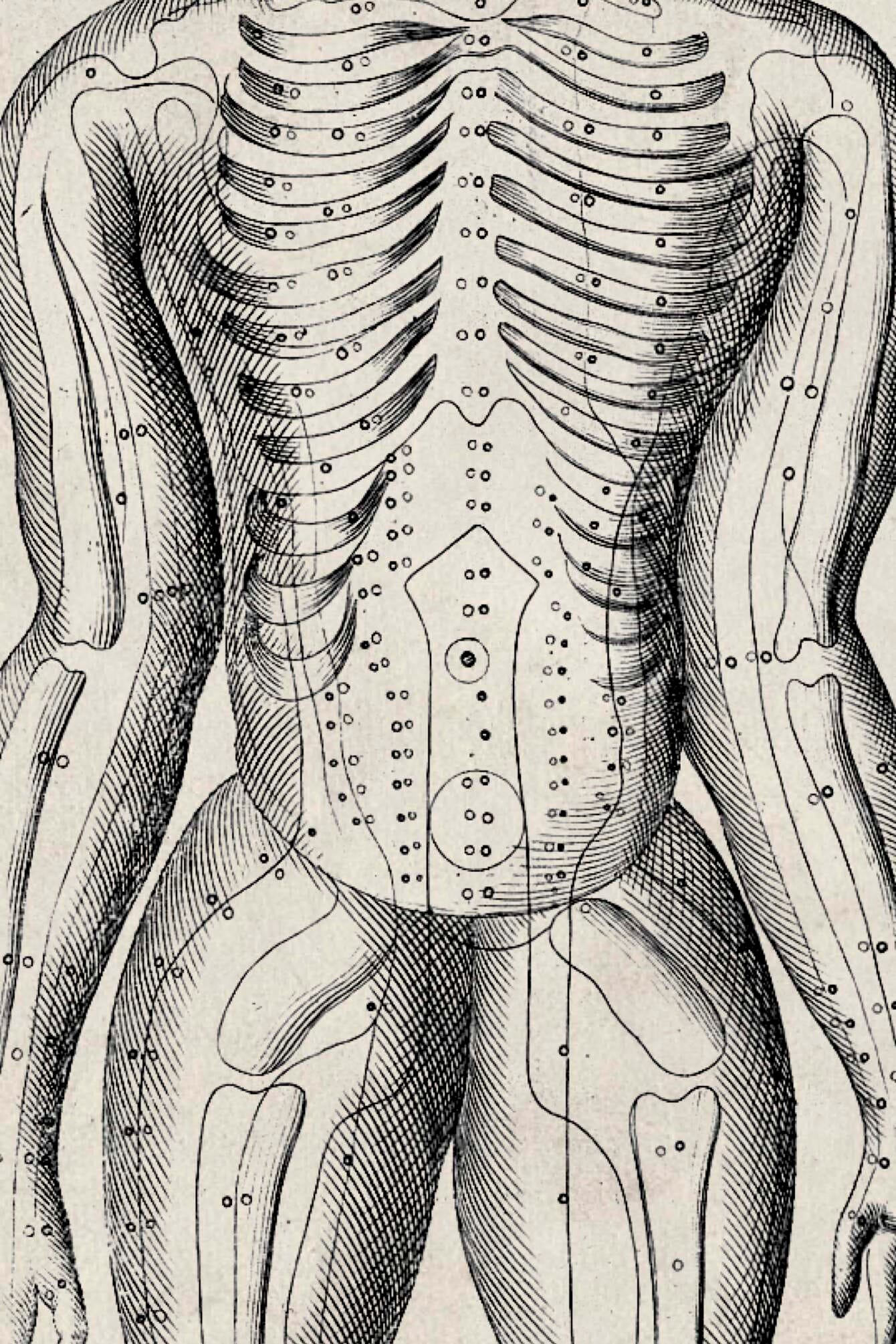
IV. The Body Without Organs
What is Foreclosed in the Symbolic is Possessed by the Imaginary and Invaded by the Real
What do we make of the body without organs, or the schizoidal form of psychosis? The body without organs is the foreclosure of the symbolic order. The body without organs lacks the symbolic function of the meridian structure. Therefore, psychosis must not be punctured at the level of the meridian, it must be fumigated on the surface.
The meridians are the territorializing flows in the official regime of the body. The body without organs is thus deterritorialized—it bears no cultural inscription even while it records the real on the anatomy of its surface. Officials without orders are crooked servants in an imperious curse, their master an emperor in abdication.
If the organs hold the spirits, then a body without organs is a hungry ghost, punished with paranoia. What he knows is everything that possesses the open spaces with messages produced by and for the socius. In place of spirits are traces of litter from the defiles of the signifier, a surplus without value in the capital bones of the body.
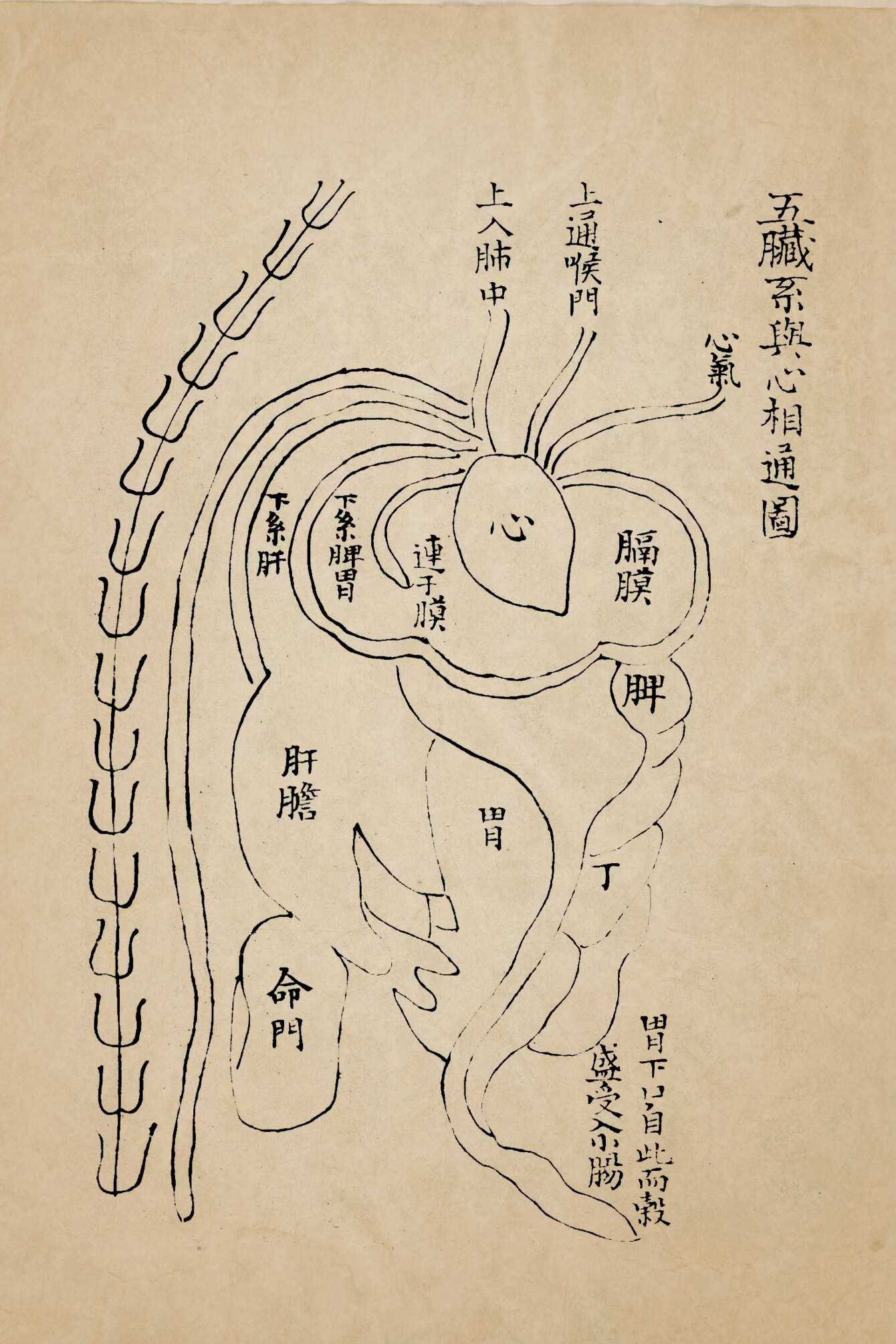
Psychosis lives in a kaleidoscopic field of human space, where the gaze is a visionary threat from the real. The psychosis of the meridian is a schizoidal splitting of names, where pathways are emptied of organic functions, left hanging like the strings of puppetry acts—the echo of their jouissance a haunt of the real.
V. The Clinic of the Real
Sooth-Saying is the Liturgy of a Boundless Self-Confession
What will suture these loose threads if not the formless acuity of analysis itself? How will the holy spirit of the signifier voice new truths in readable pictograms, rightside up?
Who will cast the last pantomime of this clinical theater? And where will the body without organs take its final flight—at the foolish precipice of the real?
Who will tremble at the second coming and the delirium of its revelations?
Whose hand will anneal the palms of pilgrims,
renunciated and raised,
in a palace of weariness?
The audacity of boundless self-confessions
rings true in a listening palace,
an auricle of the heart,
where the sovereign of the real
eternally enthrones.
If these questions are spoken in vain,
then I submit their testimony
before the audits of a witnessing body,
until only the real remains in place and sight.
Shudō Denmei, Japanese Classical Acupuncture: Introduction to Meridian Therapy (Eastland Press, 1990), 4.
The classical period refers to the fertile moment of the Edo period, when a distinctly Japanese style of acupuncture developed independently from Chinese influence.
Denmei, Japanese Classical Acupuncture, 6.
Denmei, 7.
Peter Eckman, In the Footsteps of the Yellow Emperor: Tracing the History of Traditional Acupuncture (Long River Press, 2007), 108.
Lucia Candelise, “The Legitimacy of Acupuncture in France: A Medical Innovation Under the Aegis of Tradition (Late Nineteenth to Early Twenty-First Centuries).” East Asian Science, Technology and Society: An International Journal, no. 3 (2015): 373-399, https://doi.org/10.1007/s11873-010-0126-z
In 1955, France passed a law restricting the practice of acupuncture to medical doctors.
Jacques Lacan, “The Neurotic’s Individual Myth”, The Psychoanalytic Quarterly, 48 (1979): 405-425.
Lacan, “The Neurotic’s Individual Myth”, 406.
Jacques Lacan, The Seminar of Jacques Lacan: Book XVIII: On a Discourse that Might not Be a Semblance, ed. Jacques-Alain Miller, trans. Bruce Fink (Polity Press, 2025), 45.
Lacan, Seminar XVIII, 45.
See Georg Groddeck, The Book of the It (Vision Press, 1950).
Their work became influential on two important figures in the Western transmission of acupuncture: Leon Hammer, a psychoanalyst-turned-acupuncturist, and J.R. Worsley, progenitor of the neoclassical “five-element acupuncture” system that became a prominent stream of practice.
See the repertory compiled in Denis and Joyce Lawson, Acupuncture Handbook (Health Science Press, 1973), 83-132.
Denis and Joyce Lawson-Wood, The Five Elements of Acupuncture and Chinese Massage (Health Science Press, 1965), 87.
Denis and Joyce Lawson-Wood, The Five Elements of Acupuncture and Chinese Massage (Health Science Press, 1965), 87.
Lawson-Wood, 87.
Lawson-Wood, 87.
Given that Lawson-Wood were writing in 1965 in the UK, it is not far-fetched to suspect that their comments regarding the “torment and distress” of psychoanalysis were likely informed by the school of Melanie Klein, whose incisive approach was prevalent and influential at this time.
Lawson-Wood, 87-88.
Lawson-Wood, 88.
See Appendix C in Neeshee Pandit, “Spirits of the Unconscious: Possession and Resurrection in Acupuncture Therapeutics” (master’s thesis, Middle Way Acupuncture Institute, 2024).
Jacques Lacan, Écrits: The First Complete Edition in English, trans. Bruce Fink (W.W. Norton and Company, 2006), 519.
Lacan, Écrits, 371.
Lacan, Écrits, 223.
Lacan, Seminar XVIII, 49.
Lacan, Seminar XVIII, 61.
George Soulié de Morant, Chinese Acupuncture [L’Acuponcture chinoise], trans. Lawrence Grinnell, Claudy Jeanmougin, Maurice Leveque (Paradigm Publications, 1994), 159.
Jacques Lacan, The Seminar of Jacques Lacan: Book XVIII: On a Discourse that Might not Be a Semblance, ed. Jacques-Alain Miller, trans. Bruce Fink (Polity Press, 2025), 104.
Lacan, Écrits, 157.
Lacan, Écrits, 515.
Soulié de Morant, Chinese Acupuncture, 24.
Critics of Soulié de Morant claim that he (mis)translates the Chinese word mai as méridien. This is patently false. As Soulié de Morant makes clear, he is translating the term jing as méridien. In discussions of the extraordinary vessels, he renders mai as “vessel”, not “meridian”.
In Chinese, zi wu liu zhu fa. Originally translated as “law of midday-midnight” by Soulié de Morant.
Lacan, Écrits, 223.
Denmei, Japanese Classical Acupuncture, 181.
Denmei, 181.
Referential Threads
Birch, Stephen. 2012. “Overview of Japanese acupuncture in Europe”. Japanese Acupuncture and Moxibustion 8 (1): 1-3.
Candelise, Lucia. 2015. “The Legitimacy of Acupuncture in France: A Medical Innovation Under the Aegis of Tradition (Late Nineteenth to Early Twenty-First Centuries).” East Asian Science, Technology and Society: An International Journal 19 (2): 168–89. doi:10.1080/18752160.2025.2504255.
Candelise. Lucia. 2010. “George Soulié de Morant: le premier expert Français en acupuncture” [George Soulié de Morant : The First French Expert in Acupuncture]. Revue de synthèse, 131 (3): 373–399. https://doi.org/10.1007/s11873-010-0126-z
Deleuze, Gilles; Guattari, Felix. Anti-Oedipus: Capitalism and Schizophrenia. Translated by Robert Hurley, Mark Seem, and Helen R. Lane. Penguin Books, 1972.
Denmei, Shudō. Japanese Classical Acupuncture: Introduction to Meridian Therapy. Translated by Stephen Brown. Eastland Press, 1990.
Dubal, Léo. Sooth-Dreaming on Chinese Characters: Algorithmic Oneirocriticism after “Memories of the Jade Box”.
Datong, Huo. “Deux procédés de la pensée inconsciente. Une étude comparative sur les rêves et les caractères chinois.” La Clinique Lacanienne 6, no. 1 (2003): 59. https://doi.org/10.3917/cla.006.0059.
Eckman, Peter. In the Footsteps of the Yellow Emperor: Tracing the History of Traditional Acupuncture. Long River Press, 2007.
Freud, Sigmund. The Interpretation of Dreams. Translated by James Strachey. Basic Books, 1955.
Groddeck, Georg. The Book of the It. Vision Press, 1950.
Lacan, Jacques. “The Neurotic’s Individual Myth”. The Psychoanalytic Quarterly 48 (1979): 405–425.
Lacan, Jacques. Écrits: The First Complete Edition in English. Translated by Bruce Fink. W.W. Norton and Company, 2006.
Lacan, Jacques. The Seminar of Jacques Lacan: Book XVIII, On a Discourse that Might not Be a Semblance. Edited by Jacques-Alain Miller. Translated by Bruce Fink. Polity Press, 2025.
Lawson-Wood, Denis, and Joyce. Five Elements of Acupuncture and Chinese Massage. Health Science Press, 1965.
Lawson-Wood, Denis and Joyce. Acupuncture Handbook. Health Science Press, 1973.
Pandit, Neeshee. “Spirits of the Unconscious: Possession and Resurrection in Acupuncture Therapeutics”. Master’s thesis, Middle Way Acupuncture Institute, 2024.
Pei, Fang Jing; Juwen, Zhang. The Interpretation of Dreams in Chinese Culture. Weatherhill, 2000.
Soulié de Morant, George. L’Acuponcture chinoise. Mercure de France, 1939-1941.
Soulié de Morant, George. Chinese Acupuncture [l’Acuponcture Chinoise]. Translated by Lawrence Grinnell, Claudy Jeanmougin, Maurice Leveque. Paradigm Publications, 1994.
Soulié De Morant, George. “Les Rêves Étudiés Par Les Chinois.” Annotated by Marie Bonaparte. Revue Française de Psychanalyse 1, no. 4 (1927).
Zhen, Xu. Yùxiájì (Memories of the Jade Box). Haiyang Press, 1993. Original work ca. 239 CE.