

In this episode, we dive into one of Jacques Lacan’s most foundational essays from the Écrits: "The Signification of the Phallus". Originally delivered at the Max Planck Society in 1958, Lacan’s brief but dense essay elevates the phallus from its biological underpinnings to the mark of the signifier.
As Lacan explains, the phallus and its accompanying castration complex “cannot be solved by reducing things to biological data”,1 and even more, that “these facts reveal a relation between the subject and the phallus that forms without regard to the anatomical distinction between the sexes . . .”.2
What is the significance of the phallus then? This question brings us to the core of Lacan’s contribution: that the phallus is itself a signifying function. As he writes:
For the phallus is a signifier, a signifier whose function, in the intrasubjective economy of analysis, may lift the veil from the function it served in the mysteries. For it is the signifier that is destined to designate meaning effects as a whole, insofar as the signifier conditions them by its presence as signifier.3
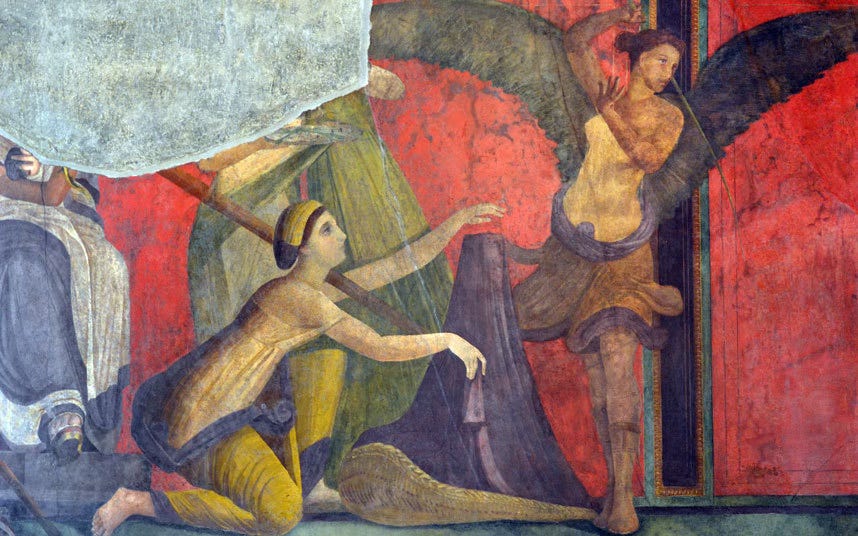
Lacan is referencing the Dionysian mysteries, where the “demon of shame springs forth at the very moment the phallus is unveiled in the ancient mysteries (see the famous painting in the Villa of the Mysteries in Pompeii)”.4
Lacan thus expands the phallus from a physical organ to an organon, or instrumental logic that governs human desire, language, and the unconscious. As Lacan says, “The phallus is the privileged signifier of this mark in which the role of Logos is wedded to the advent of desire”.5
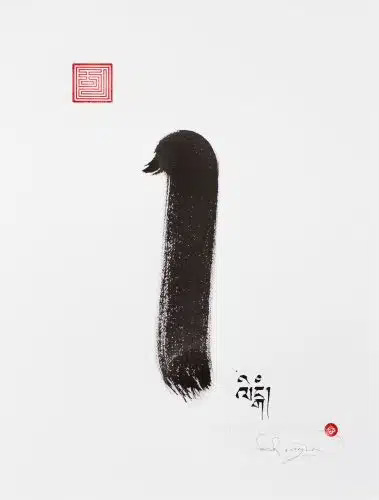
His emphasis on the term mark in relation to the signifier also brings forth parallels with the Sanskrit term lingam, which means “phallus”, “mark”, “characteristic”, and “symptom”. In Indian Tantra, the lingam functions as a signifier for consciousness and is ritually worshipped as the form of Śiva.
This essay also prefigures Lacan’s later formulation that “there is no sexual relationship”. Lacan writes that “the phallus as a signifier provides the ratio of desire”6 and that “the demand for love can only suffer from a desire whose signifier is foreign to it”.7
Lacan concludes his essay with a remark that gives the phallus its profound significance: “The function of the phallic signifier touches here on its most profound relation: that by which the Ancients embodied therein the Nous and the Logos”.8
The phallus thus marks a signifying stand, a proportion in the unconscious that is its ungraspable constitution. Perhaps it is here, in the consciousness of our symptom, that we must meet the mark anew.
00:00 - Introduction to Lacan’s "The Signification of the Phallus"
03:02 - Historical Context and the Definition of the Phallus
05:37 - The Logic of Being vs. Having and the Formula for Love
09:14 - The Castration Complex and the Structure of the Unconscious
15:48 - Posturing, Gender Binaryism, and the Fallible Symbolic Order
32:37 - Infantile Sexuality and the Origins of the Phallic Object
46:45 - Narcissism, Dialectics of Jealousy, and Transitivism
49:06 - The Phallus as a Signifier and the Dionysian Simulacrum
56:38 - "Lingam", Consciousness, and the Mark of the Signifier
01:01:01 - Meaning Effects, Incel Culture, and Hypermasculinity
01:04:24 - Evolution of the Phallus: From Imaginary Lack to Sexuation
01:06:25 - Logos, Lack, and the Advent of Desire
01:09:54 - Encountering the Lack of the Other (Che Vuoi?)
01:11:58 - The Splitting of Need, Demand, and Desire
01:18:48 - Fibonacci Spiral, Möbius Strip, and the Drive
01:25:54 - Objet a as the Cause of Desire
Jacques Lacan. Écrits: The First Complete Edition in English. Translated by Bruce Fink (W.W. Norton and Company, 2006), 575.
Lacan, Écrits, 576.
Lacan, 579.
Lacan, 581.
Lacan, 581.
Lacan, 581.
Lacan, 582.
Lacan, 584.